

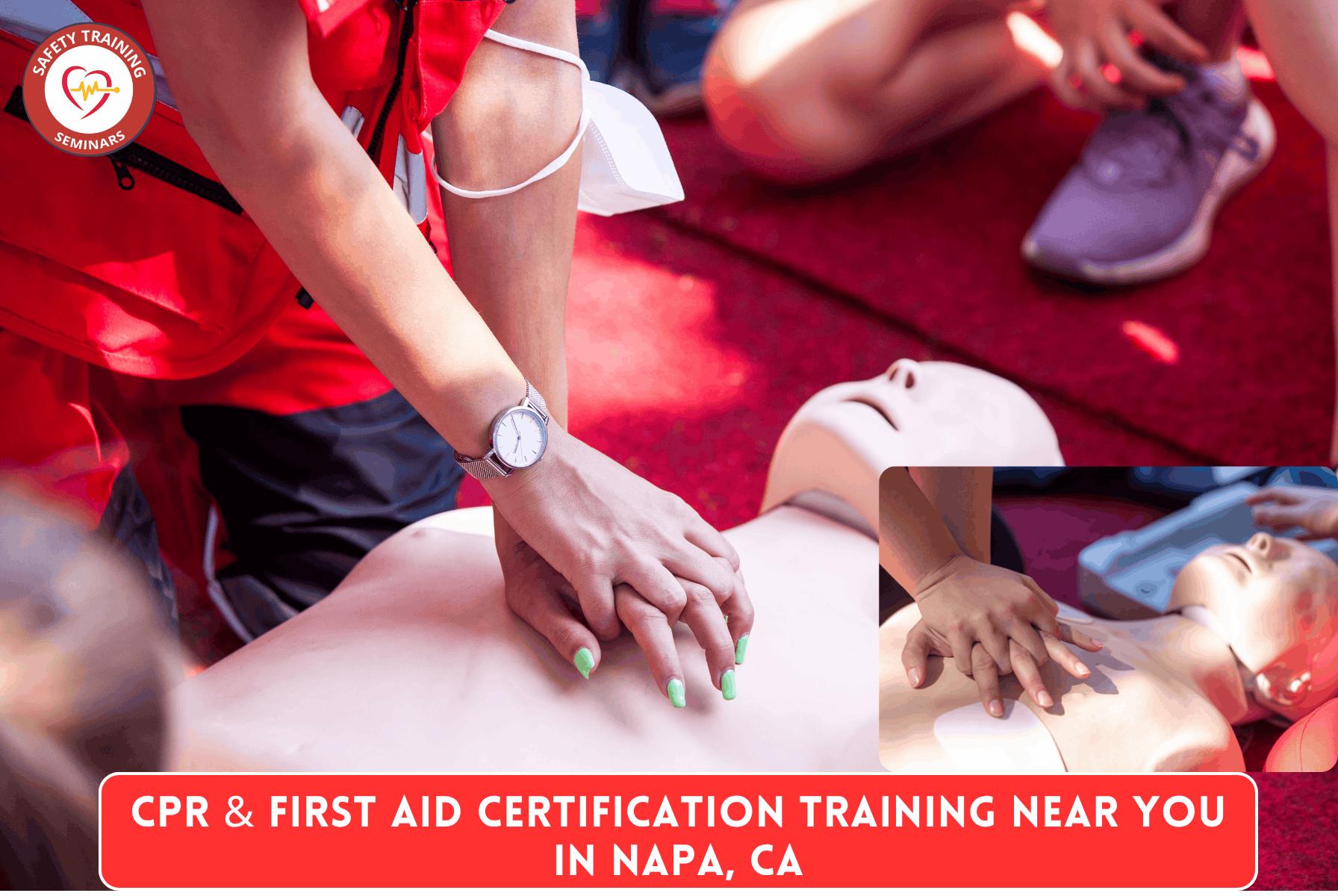
CPR & First Aid Certification Training Near You In Napa, CA
In order to successfully navigate emergency response readiness in the Napa Valley, it is necessary to have a comprehensive awareness of both clinical protocols and the concrete reality of a
CPR &First aid Training Center
Youth sports bring Napa families together through school athletics, community leagues, weekend tournaments, and recreational programs. But when a young athlete experiences sudden cardiac arrest during a practice or game, coaches and other adults must be prepared to respond quickly. California’s AB 310, the Nevaeh Youth Sports Safety Act, strengthens these expectations by establishing CPR, AED, and emergency planning responsibilities for youth sports organizations.
★★★★★ 4.98 Google Rating · 23,000+ Certified
For coaches, athletic directors, and sports administrators in Napa, understanding these requirements is an important step toward protecting young athletes. Safety Training Seminars provides American Red Cross CPR, AED, and First Aid certification courses at its Napa training location, giving local participants an opportunity to develop practical emergency response skills.
AB 310 (Chapter 254, Statutes of 2025) amended California’s Nevaeh Youth Sports Safety Act. It establishes requirements for youth sports organizations to ensure their coaches have CPR and AED certifications and that the organization maintains a written cardiac emergency response plan.
The law applies to qualifying youth sports organizations, including organizations, businesses, nonprofit entities, and local government agencies that sponsor or conduct amateur sports competitions, training, camps, or clubs involving participants aged 17 or younger.
The legislation also establishes a separate deadline for AED access during official practices and matches. A subsequent 2026 amendment, AB 387 (Chapter 502, Statutes of 2026), further addresses AED access at permanent sports facilities and coordination between facilities and youth sports organizations.
Deadline | Responsibility |
January 1, 2027 | Youth sports organizations must ensure coaches hold CPR and AED operation certifications. |
Every two years | Coaches must complete CPR and AED recertification. |
Annually | Written cardiac emergency response plans must be reviewed with coaches and staff. |
Annually | Parents or guardians must receive electronic communication containing the emergency plan or a link, AED locations, and designated staff contacts. |
January 1, 2028 | Youth sports organizations must ensure AED access during official practices and matches, subject to the law’s facility provisions. |
January 1, 2028 | Applicable AED maintenance and testing requirements begin. |
The emergency response plan must identify AED locations, explain procedures for sudden cardiac arrest, assign responsibilities to coaches, administrators, and athletes, and explain how relevant people will receive information and training.
AB 387 also provides for permanent sports facilities to procure, maintain, and make their AEDs accessible to youth sports organizations during permitted activities. Where an operational AED is not available at the facility, the organization must ensure access to one throughout the practice or match.
Napa has a diverse youth sports environment, making emergency planning relevant across school campuses, recreation facilities, and community athletic programs.
The Napa Valley Unified School District offers high school sports including football, basketball, soccer, wrestling, baseball, softball, swimming, and track and field. Napa High School and Vintage High School both maintain active athletic programs, where coaches supervise student-athletes throughout different sporting seasons.
Community leagues also contribute to Napa’s athletic landscape. The City of Napa identifies organizations and programs including Napa Little League, Napa Babe Ruth/Cal Ripken Baseball, Napa Youth Soccer League, Napa Valley Soccer Club, Napa Nighthawks Football and Cheer, and Napa Optimist Youth Basketball.
Public athletic facilities create additional opportunities for sports participation. John F. Kennedy Park, Kiwanis Park, and Harvest Recreation Complex provide fields and facilities used for sporting activities, leagues, and tournaments.
Each environment presents different emergency response considerations. A football coach may need to recognize a cardiac emergency during outdoor practice, while a basketball coach may need to respond inside a busy gymnasium. Baseball and soccer coaches must also understand how to activate emergency services and locate available AED equipment.
For these reasons, CPR knowledge, AED familiarity, and an accessible emergency response plan should be part of a youth sports organization’s overall safety preparation.
Cardiac emergencies can happen unexpectedly, even during activities that appear routine. Recognizing the warning signs and responding appropriately can make a critical difference while emergency medical services are on their way.
CPR training teaches participants how to respond when someone becomes unresponsive and is not breathing normally. Depending on the selected course, participants may learn adult, child, and infant CPR techniques, rescue breathing, and choking response.
AED education introduces participants to automated external defibrillators, including when to use the equipment and how to follow its voice and visual instructions.
First Aid training provides additional preparation for situations such as bleeding, sprains, minor injuries, and other common medical emergencies that may occur during youth sports activities.
An important legal distinction: AB 310 specifically addresses CPR certification and AED operation certification. It does not establish a general First Aid certification requirement for every coach under this provision. First Aid education is an additional training option that sports organizations may consider. Separate requirements, including those applicable to youth tackle football, may also apply.
Coaches and sports administrators looking for American Red Cross CPR and First Aid certification in Napa can explore training opportunities through Safety Training Seminars.
The local training center is located at:
Safety Training Seminars
2011 Soscol Ave, Suite 7
Napa, CA 94558
Available American Red Cross training options include CPR, AED, and First Aid courses. Participants should select a course appropriate to their responsibilities and verify that its certification meets the requirements applicable to their youth sports organization.
A suitable CPR/AED course can help participants develop knowledge of cardiac emergency recognition, CPR techniques, and AED operation. Combined First Aid, CPR, and AED training can provide broader preparation for responding to emergencies involving adults and children.
For organizations preparing for AB 310, it is particularly important to confirm that the selected course is offered by an accredited organization and is consistent with the law’s national evidence-based cardiovascular care guidelines. Do not assume that every online-only course or general First Aid class independently satisfies the statutory certification requirement.
Coaches can explore available American Red Cross CPR and First Aid certification courses in Napa to review relevant training and registration information.
Preparation should involve more than registering coaches for a certification class. Sports organizations can take several practical steps:
These steps can help Napa’s youth sports organizations build a more organized approach to emergency preparedness.
A well-prepared coach needs more than knowledge of the game. Understanding CPR, AED operation, and emergency procedures can help create a safer environment for young athletes, teammates, and spectators.
Safety Training Seminars provides American Red Cross CPR, AED, and First Aid certification opportunities in Napa. Explore the Napa CPR and First Aid certification course options and take a practical step toward stronger youth sports emergency preparedness.
We are an official American Heart Association Authorized Training Center. Every card we issue is genuine, verifiable, and accepted nationwide.
Pass your skills evaluation and walk out with your official AHA provider card in hand — no waiting, no mailing, no delays.
Early morning, afternoon, evening, and weekend classes available throughout the week. Book online or by phone in minutes.
Our instructors are active healthcare professionals — nurses, paramedics, and physicians who bring real clinical experience to every class.
FREQUENTLY ASKED QUESTIONS
Key information for healthcare professionals and students about Assembly Bill 310: Nevaeh Youth Sports Safety Act – CPR and First-Aid Certification In CITY California.
The Nevaeh Youth Sports Safety Act is California legislation addressing sudden cardiac arrest preparedness in youth sports. AB 310 amended the law to require CPR and AED certification for coaches, written cardiac emergency response plans, and AED access during official practices and matches according to specified implementation dates.
The coach certification requirement begins January 1, 2027. Qualifying youth sports organizations must ensure their coaches are certified in CPR and AED operation by that date. Recertification is required at least every two years.
No. The relevant AB 310 provision specifically establishes CPR and AED certification requirements. First Aid training offers additional emergency response knowledge, but it should not be presented as a universal requirement under this provision.
Under AB 310, coaches must be recertified at least every two years. Organizations should maintain accurate certification records and arrange renewal training before existing credentials expire.
Yes. Qualifying organizations must maintain a written cardiac emergency response plan, review it annually with coaches and staff, document AED locations and emergency procedures, and communicate the required information to parents or guardians annually.
Safety Training Seminars offers American Red Cross CPR, AED, and First Aid training at 2011 Soscol Ave, Suite 7, Napa, CA 94558. Coaches can review available courses and registration information through the Napa CPR training website.
The AED access requirement takes effect January 1, 2028. AB 387 also establishes provisions for permanent sports facilities to make their AEDs accessible during permitted youth sports activities and addresses arrangements when an operational AED is not available at a facility.
Safety Training Seminars in Napa, CA Offers American Red Cross CPR, AED, and First-Aid Training for Local Coaches, helping Sport Coaches obtain important education conveniently and affordably.
AHA Authorized · Same-Day Cards · Mon–Sat 8am–10pm
CPR RESOURCES & NEWS
In order to successfully navigate emergency response readiness in the Napa Valley, it is necessary to have a comprehensive awareness of both clinical protocols and the concrete reality of a
If you need an American Heart Association (AHA) PALS class in Napa, Safety Training Seminars runs PALS training at its Napa CPR Training Center on Soscol Avenue. The program combines
If you are a healthcare professional practicing in the Napa Valley region, maintaining your Advanced Cardiovascular Life Support credentials is a critical step for your career and clinical readiness. Finding